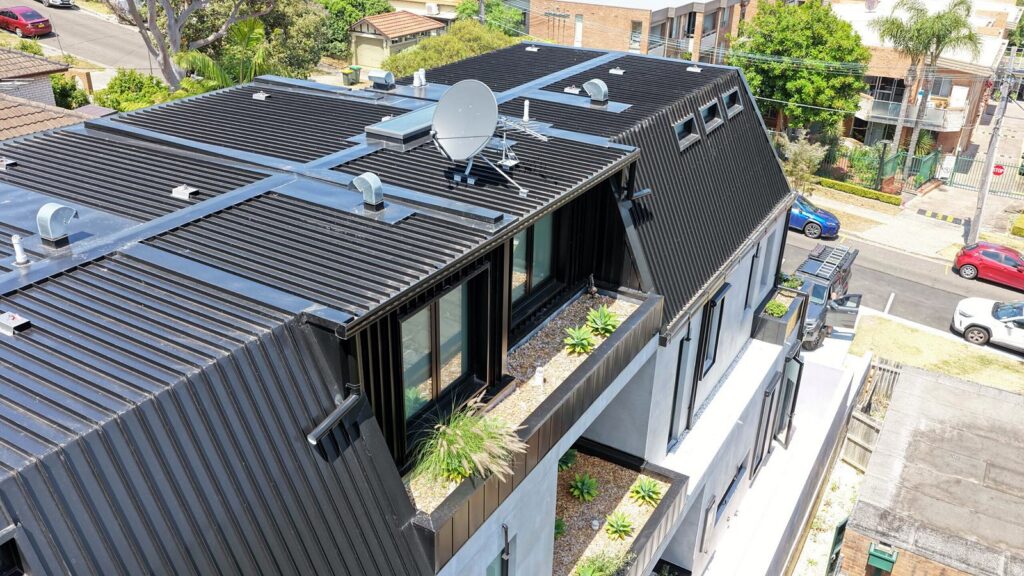
A box gutter sits inside the footprint of the building, usually between two roofs or behind a parapet. When an eaves gutter overflows, water lands outside. When a box gutter fails or overflows, it lands in your ceiling, your stock, your switchboard or your classroom.
This page is about box gutters on commercial, industrial and public buildings: how to tell a gutter is finished, what a replacement has to get right on sizing, overflow and materials, and how the work is staged over a building that stays open.
Signs a commercial box gutter needs replacing
| What you see |
Likely cause |
Usually |
| Water stains or drips on ceilings along a gutter line |
Leaking joints, corrosion through, or overflow |
Inspect first: could be either |
| Rust at laps, joints or the sole of the gutter |
Coating failure, standing water, debris |
Replace if widespread |
| Water ponding long after rain |
Gutter has sagged or lost its fall |
Replace |
| Failed or patched sealant along joints |
Age, movement, repeated repairs |
Replace if most joints are affected |
| Gutter overflows in heavy storms only |
Undersized gutter, sump or outlet, or no overflow |
Redesign at replacement |
| Holes or thinning near sumps and outlets |
Where water and debris concentrate |
Replace sump and adjacent run at minimum |
| Previous patching across many sections |
A gutter that has already been repaired past its life |
Replace |
One stain does not condemn a gutter. Widespread corrosion, lost fall or a design that overflows every big storm does.
Repair or replace?
A local failure, such as one failed joint, a blocked sump or a damaged section, is roof repairs and maintenance work. Replacement makes sense when corrosion is general, the gutter has lost its fall, it has been patched repeatedly, or it was never sized for the roof it drains.
That call is made on a commercial roof inspection, which looks at the gutter, the sumps and outlets, the roof sheeting ends that discharge into it, and the ceiling below. If the roof sheeting itself is at the end of its life, the box gutter is usually replaced as part of a re-roof rather than on its own.
Sizing and overflow: the part you cannot see
Box gutters in Australia are designed to AS/NZS 3500.3, the stormwater drainage part of the plumbing and drainage standard. The current edition is AS/NZS 3500.3:2025, with Amendment 1 issued in 2026. The design accounts for the roof catchment area draining into the gutter, the rainfall intensity for the building’s location, the gutter’s width, depth and fall, and the number and size of outlets.
We are not going to quote sizing figures here, because they depend on the building, and they should come from the design for your roof. What matters for a facility manager is the principle: a box gutter must have somewhere safe for water to go when it is overwhelmed, and that somewhere must be outside the building.
Older gutters were often designed to earlier rules or have had roof area added to them since. A replacement is the point to check the existing gutter, sumps and overflows against the current standard rather than copying what failed.
Sumps and rainheads
- Sumps are deepened boxes at the outlet of a box gutter that collect water and feed it into the downpipe. They are where debris gathers and where corrosion usually starts.
- Overflows let water escape safely when the outlet cannot keep up, through an overflow device in the sump or a weir through the parapet, discharging to the outside of the building.
- Rainheads sit on the outside of the wall where the gutter discharges through it, collecting water before the downpipe and providing an overflow point that is visible from the ground.
All three are replaced with the gutter. Reusing an old sump on a new gutter puts the weakest point back in the system.
Where new outlets connect to the building’s downpipes and stormwater system, those connections are made by a licensed plumber where required. Confirm in the scope who makes each connection before work starts.
Materials for concealed commercial gutters
| Material |
Strengths |
Watch for |
| Colorbond steel |
Pre-painted, wide colour range, economical |
Coating life where water and debris sit; cut edges and joints |
| Zincalume steel |
Economical, good general corrosion resistance |
Contact with or runoff from copper and lead; wet debris, wet concrete or treated timber in contact |
| Stainless steel |
Long life in a concealed position, can be welded for continuous joints |
Higher material cost; grade must suit the environment |
Two rules apply to all three. The gutter material must be compatible with the roof sheet and flashings it meets, and with any metal whose runoff reaches it. And because a box gutter is out of sight, it should be specified for the life of the roof, not the lowest first cost.
Replacing a box gutter over an operating building
A box gutter replacement on a commercial building is done with the building occupied below, so the method matters more than on a house.
- Inspect and measure. Gutter lengths, sumps, outlets, sheet ends and ceiling access.
- Fabricate before you open. New gutters, sumps and rainheads are made to measure before the old gutter comes out, so the gap is as short as possible.
- One run at a time. Remove and replace in sections that can be closed the same day, with temporary drainage in place.
- Watch the weather. No run is opened against a forecast it cannot be closed before.
- Sheet ends and flashings. Roof sheet ends turned down into the new gutter, and flashings renewed where they meet it.
- Safe access. Box gutters are often reached only across the roof, past skylights and fragile sheeting. Access and fall protection are planned first; see height safety systems.
- Test and hand over. Outlets and overflows checked, and the gutter left clean.
When the gutter is part of a full re-roof, it goes in while the roof is open. Our industrial roof replacement in Rydalmere is an example: 650 m² of roof removed and replaced in two weeks, all services reinstated, and a new guttering system installed to improve drainage and long-term weather protection. More on whole-roof work on our industrial roofing page.
Frequently asked questions
How do I know if my box gutter needs replacing or just repairing?
Local damage can be repaired. Widespread corrosion, lost fall, repeated patching or a gutter that overflows in every heavy storm points to replacement. An inspection from the roof and the ceiling below settles it.
Why does my box gutter overflow into the building?
Usually a blocked or undersized outlet, a gutter too small for its catchment, or no effective overflow. A replacement should be checked against AS/NZS 3500.3 rather than copied from the gutter that failed.
Which material suits a commercial box gutter?
It depends on the roof it serves, the environment and the budget. Stainless steel offers long life in a concealed position; Colorbond and Zincalume steel are more economical. Compatibility with the roof sheet and any copper or lead runoff matters as much as the material itself.
Can a box gutter be replaced without replacing the roof?
Often, yes, if the roof sheeting is in good condition. The sheet ends at the gutter are lifted, the gutter replaced, and the ends turned down and flashed. If the sheeting is near the end of its life, it is cheaper to do both together.
Can the building stay open during the work?
Usually, yes. The usual approach is to make the new gutters before the old ones come out and replace one run at a time, with each section closed the same day.
How long does a box gutter replacement take?
It depends on the length of gutter, the number of sumps and the access. A programme can only be set after an inspection.
Leaking box gutter? Send us photos
Austek has been working on Sydney roofs since 2010, including full commercial roofing and industrial re-roofs, and our roof repairs and maintenance work covers drainage problems. Every building and gutter is different, so send photos of the gutter and the ceiling below it, the building address and what you have seen, and call to check availability for your job.
Send us photos of the gutter or call 0411 922 441.