
Height safety on a commercial or industrial roof means anchor points, static lines, guardrails, walkways and access ladders. It works best when it is planned around the roof it sits on, and where a re-roof is coming, built in with the new sheeting.
As commercial and industrial roofers, we look at height safety from the roof up: the access route people actually use, the structure anything has to be fixed into, and how every fixing is flashed into the sheeting. We supply and install height safety solutions tailored to your roof structure, including anchor points, walkways and static lines.
If the roof itself needs work first, see commercial roofing.
NSW work health and safety law does not treat all fall protection equally. Where work at height cannot be avoided, the risk has to be controlled in a ranked order:
This order matters when you are deciding what to install. An anchor point only protects a trained person wearing a correctly fitted harness, attached at the right moment. A guardrail protects the air conditioning technician who has never been on your roof before. For a roof visited often, by many different contractors, passive protection along the main access route is usually the better investment, with anchors and static lines covering the areas rails cannot reach.
A single-point anchor fixed to the roof structure, used with a harness and lanyard for fall arrest or restraint. AS 5532:2025 sets the manufacturing requirements for single-point anchor devices. It was published in September 2025, replacing AS/NZS 5532:2013, and is now an Australian rather than a joint Australian and New Zealand Standard. Placement is the hard part: each anchor has to let a worker reach the task without a swing fall, and has to be fixed into structure that can take the load, not just the sheet.
A horizontal lifeline run between end and intermediate anchors, which lets a worker travel along a roof while staying connected. Static line installation is a system design job: the number of people using the line at once, the span between supports, the line’s deflection under load, and the clear fall distance below all have to be accounted for, and the layout should be designed before anything is fixed.
Permanent rails along roof edges, around plant, and beside openings. Passive protection, so nobody has to clip on. AS 1657 covers the design, construction and installation of fixed platforms, walkways, stairways and ladders, including their guardrailing. The current edition is AS 1657:2018.
A defined route across the roof to plant, gutters and hatches. A walkway keeps foot traffic off the sheeting, which protects the roof as much as the worker: dented ribs and cracked coatings from repeated foot traffic are a common source of corrosion and leaks on commercial roofs.
Fixed ladders, step-over platforms at parapets and level changes, and roof hatch access, also covered by AS 1657.
Old skylights and translucent sheeting are a recognised cause of serious falls through roofs. Screening or replacing them belongs in the same plan, together with roof safety mesh under the sheeting.
Retrofitting anchors through finished sheeting means penetrating a sound roof and then flashing every penetration. Installing rails, walkways and anchors as part of a re-roof means fixing to the structure while it is exposed, and flashing details designed in from the start.
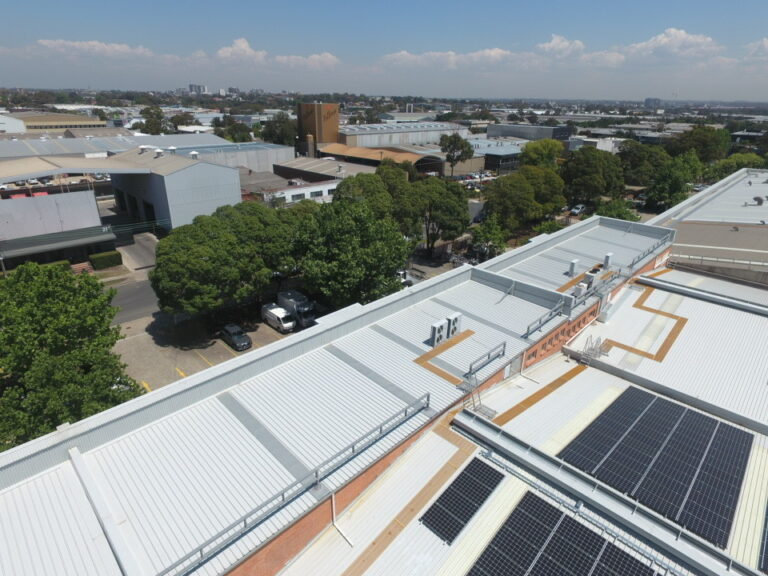
That is how the safety work was done at Silverwater, where safety rails and walkways were integrated with the new roof: a full replacement to Speed Deck on a 400 m² industrial roof, delivered over four weeks in a live industrial environment, with safe access maintained at height throughout. If a re-roof is on your horizon, plan the height safety with it. See industrial roofing for how those jobs run.
Installed anchors and static lines need periodic inspection by a competent person under AS/NZS 1891.4:2025, the current edition, published in September 2025. Installer summaries of the 2025 edition describe annual inspection for permanently installed anchors and static lines, and six-monthly inspection for harnesses and removable gear. SafeWork NSW’s Work on roofs code of practice (May 2026) says anchorages are inspected under AS/NZS 1891.4:2025 on a scheduled basis or before use, and that installers keep records. That record is what lets the next contractor see whether the system is in date before they rely on it.
If nobody can tell you when your anchors were last inspected, treat them as out of date until they are checked.
Height safety is also one of the six areas covered in a full commercial roof inspection, which looks at whether the system exists, whether it is in date, and whether it actually lets maintenance be done safely.
The main ones are AS/NZS 1891.4:2025 (Personal equipment for work at height, Part 4: Selection, use and maintenance), AS 5532:2025 for single-point anchor devices, and AS 1657:2018 for fixed platforms, walkways, stairways and ladders. The two 2025 editions were published in September 2025 and replace the earlier AS/NZS 1891.4 and AS/NZS 5532 editions.
On a schedule under AS/NZS 1891.4:2025, and before use. Installer summaries of the 2025 edition describe annual inspection for permanently installed anchors and static lines. Have them checked sooner after any fall, damage or major roof work.
If the roof is being replaced within a reasonable horizon, plan both together. If people are going up now without protection, the risk is now, so it cannot wait.
Often not. Anchors protect only harnessed, trained users. Guardrails and walkways protect everyone, and the law ranks them higher.
Yes. We supply and install height safety solutions tailored to your roof structure. Every roof is different, so call to check availability and talk through what your roof needs.
Tell us the building, how often people go up, and what they go up for. Tell us too if a re-roof is planned. We will look at the roof, the access route and the structure, and talk through how height safety fits with the roofing work.
Ask about height safety for your roof, or call 0411 922 441.

Heavy-duty roofing systems for factories & facilities.

Large-scale roofing for offices, warehouses & developments.

New builds, re-roofs & maintenance for homes.

Installation & certification of safety access solutions.

Integrated solar panel and roofing solutions.

Fast, reliable roof leak & storm damage repairs.
Heavy-duty roofing systems for factories & facilities.
Large-scale roofing for offices, warehouses & developments.
New builds, re-roofs & maintenance for homes.
Installation & certification of safety access solutions.
Integrated solar panel and roofing solutions.
Fast, reliable roof leak & storm damage repairs.