
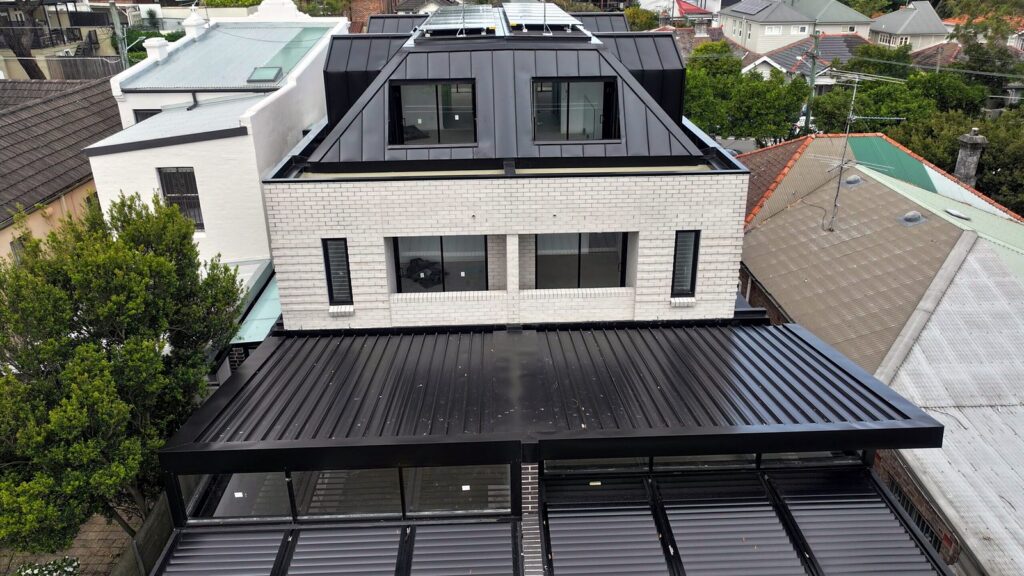
Speed Deck is a concealed-fix steel roof profile made by Stramit, and on large, low-pitch commercial and industrial roofs it is one of the profiles we reach for most. Austek has installed it on a 3,200 m² commercial development at Gregory Hills, a 3,000 m² government building at Bossley Park, and a 400 m² industrial re-roof in Silverwater.
Below: what the profile is, where it earns its place, how it compares with corrugated and trapezoidal sheeting, and the questions to settle before tender.
Speed Deck is a roll-formed steel roof sheet that clips onto brackets fixed to the purlins. No screws pass through the weather surface of the roof, so there are no fastener holes for water to find, and the clips let each sheet expand and contract along its length as the roof heats and cools. It is designed for long sheet runs at low roof pitch, which is why it turns up on warehouses, factories, schools and public buildings.
Stramit’s current version of the profile is Speed Deck Ultra. The figures below are from Stramit’s published data for it.
| Specification | Figure |
|---|---|
| Fixing method | Concealed, clip-fixed to the purlins. No fasteners through the weather surface. |
| Cover width | 700mm |
| Ribs | 43mm high, at 233mm centres |
| Minimum roof pitch | 1 degree for many applications |
| Base metal thicknesses | 0.42mm or 0.48mm, G550 steel |
| Maximum roof spans, 0.42 BMT | 2100mm internal, 1750mm end, 1700mm double or equal spans |
| Maximum roof spans, 0.48 BMT | 2700mm internal, 2250mm end, 2300mm double or equal spans |
| Finishes | Colorbond and Zincalume steel (not every Colorbond finish is offered, and some are subject to availability) |
The roof spans are published for N1 wind classification, Region A, buildings 7m high or less, on steel supports 1.5mm thick or more. Other wind classes and wall applications have their own tables. Design to the manufacturer’s current tables, not this page.
It is not automatically the right answer. A small roof broken up by plant, penetrations and changes of direction can lose the advantage, because every cut-out needs detailing around the clip system. For a wider view of the decision on commercial roofing and industrial roofing projects, start from the building, not the profile.
The three profiles that cover most of Sydney’s commercial and industrial roof area, compared on the points a specifier gets asked about.
| Speed Deck (concealed-fix) | Corrugated | Pierce-fixed trapezoidal | |
|---|---|---|---|
| How it is fixed | Clipped to brackets on the purlins | Screwed through the sheet | Screwed through the rib crests |
| Fasteners on the weather surface | None | Many | Many |
| Pitch it suits | Low pitch, long runs | Steeper pitch; needs more fall | Lower than corrugated |
| Thermal movement | Sheets slide on the clips | Taken up at the fixings | Taken up at the fixings |
| Appearance | Clean, wide pans, no visible screws | Traditional curved profile | Strong ribs, visible fixings |
| Local repair | Needs care: sheets interlock along their length | Straightforward | Straightforward |
| Typical use | Warehouses, schools, public buildings, commercial developments | Industrial sheds, re-roofs over existing purlins, heritage | Factories, warehouses, budget-driven industrial roofs |
For Stramit’s own profiles, its Roof Slope Design Guide (2023) gives minimum pitches of 5 degrees for Corrugated, 3 for Longspan, 2 for Monoclad and 1 for Speed Deck Ultra. Other manufacturers’ profiles have their own tables. For the broader system decision, read our guide to choosing a roofing system for a commercial building.
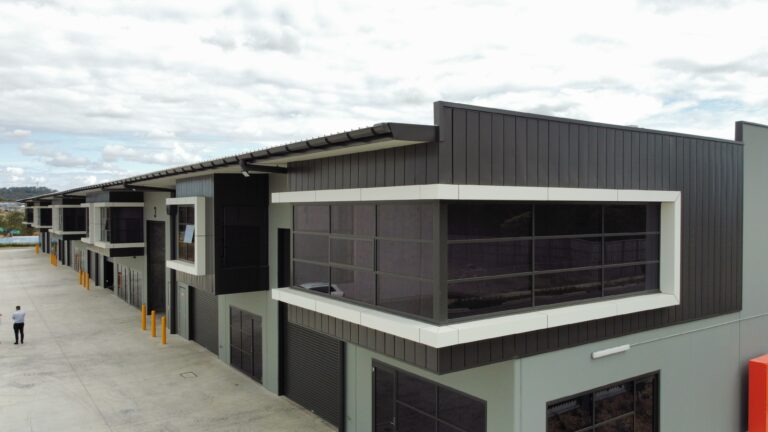
Gregory Hills, commercial, 2019. A new Speed Deck roof and wall cladding at Gregory Hills: 3,200 m² of roof and 600 m² of walls in four weeks, with Interlock 305 wall panels and monument wall construction. The hard part was the transition between the Speed Deck roof and the wall panels. Roof and facade were sequenced so neither trade waited on the other.
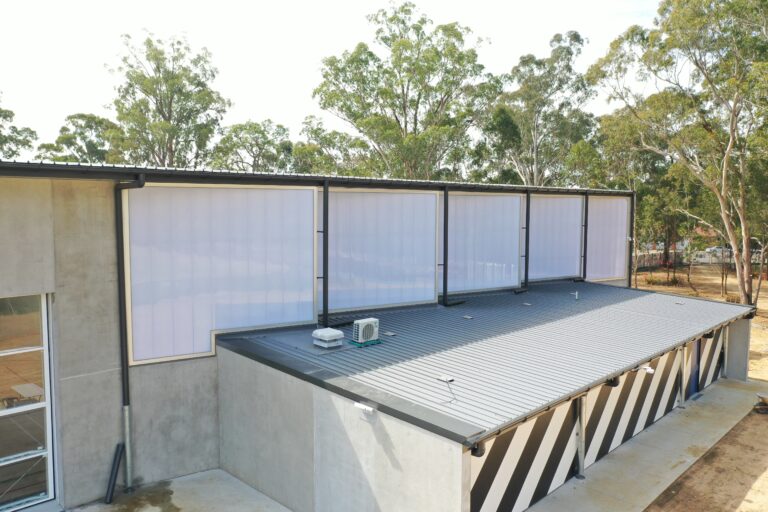
Bossley Park, government, 2022. A 3,000 m² Speed Deck roof and 1,200 m² of Danpalon wall system on a government building at Bossley Park, delivered in six weeks with monument roof elements. Same lesson: the weather performance of the building came down to the detailing where the roof met the translucent wall system.
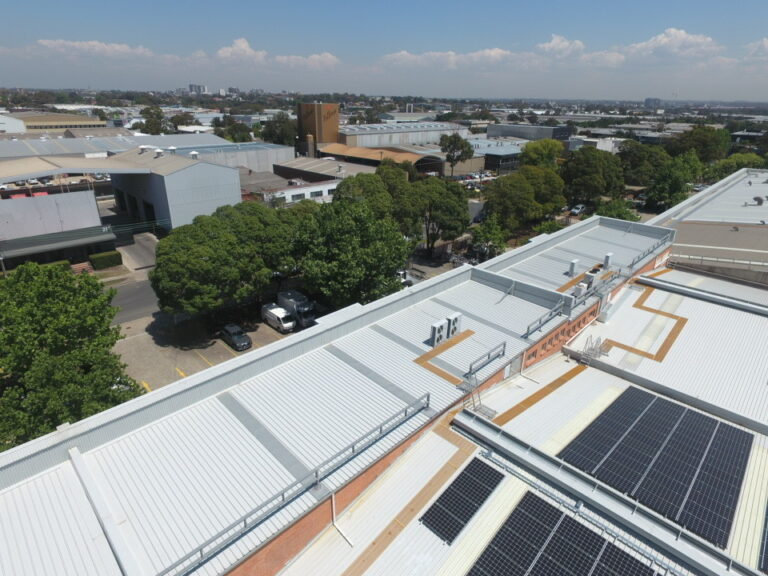
Silverwater, industrial, 2018. A Silverwater industrial re-roof to Speed Deck: 400 m², four weeks, full removal of the old roof in a live industrial environment, with safety rails and walkways built into the new roof.
Read those three together and the pattern is clear. Silverwater was a tenth of the Gregory Hills roof area and took the same four weeks, because it was a strip-and-replace over an operating site with safety infrastructure added. Area sets the materials order. Scope and site conditions set the programme.
Every item is something we will ask before we price.
On an existing building the profile change is only possible if the frame allows it. Purlin spacing, pitch and the condition of the purlins themselves decide whether Speed Deck can go straight on or needs structural work first. That is established on a commercial roof inspection before anyone prices sheet.
No. Both are concealed-fix, but Speed Deck is a clip-fixed, roll-formed profile with interlocking ribs, while a standing seam roof joins its pans with a raised seam that is snapped or mechanically folded. Our page on standing seam roofing covers that system.
Stramit gives 1 degree for many applications of Speed Deck Ultra. Design to the manufacturer’s tables and measure the built pitch on an existing roof.
Yes, following Stramit’s Foot Traffic Design Guide: walk in the pans, not on the ribs, except over supports. Where heavy foot traffic is expected, the guide cuts the 0.48 BMT spans to 1400mm internal and 900mm end. Where maintenance access is regular, designated walkways are the answer, as they were at Silverwater.
Often, subject to the existing purlin spacing, the pitch and the condition of the frame. That is checked on site before it is quoted.
Yes, in Colorbond and in unpainted Zincalume. Not every Colorbond finish is offered on the profile and some are subject to availability, so check the colour before it is specified.
It depends on scope more than area. Our three Speed Deck jobs ran four weeks for 400 m² at Silverwater, four weeks for 3,200 m² plus walls at Gregory Hills, and six weeks for 3,000 m² plus walls at Bossley Park.
Send us the roof plan, the pitch if you know it, and whether it is a new building or a re-roof over an operating site. We will come back with the questions that matter for your building and a programme that fits it.
Austek has been working on Sydney commercial, industrial and government roofs since 2010. Send us your roof plan or call 0411 922 441.

Heavy-duty roofing systems for factories & facilities.

Large-scale roofing for offices, warehouses & developments.

New builds, re-roofs & maintenance for homes.

Installation & certification of safety access solutions.

Integrated solar panel and roofing solutions.

Fast, reliable roof leak & storm damage repairs.
Heavy-duty roofing systems for factories & facilities.
Large-scale roofing for offices, warehouses & developments.
New builds, re-roofs & maintenance for homes.
Installation & certification of safety access solutions.
Integrated solar panel and roofing solutions.
Fast, reliable roof leak & storm damage repairs.